Reading Nutrition Labels

The Nutrition Facts label is a guide to help you pick healthier foods and meals to go on your Healthy Eating Plate. It can help you spot foods that are good for you.

How to read Nutrition Labels
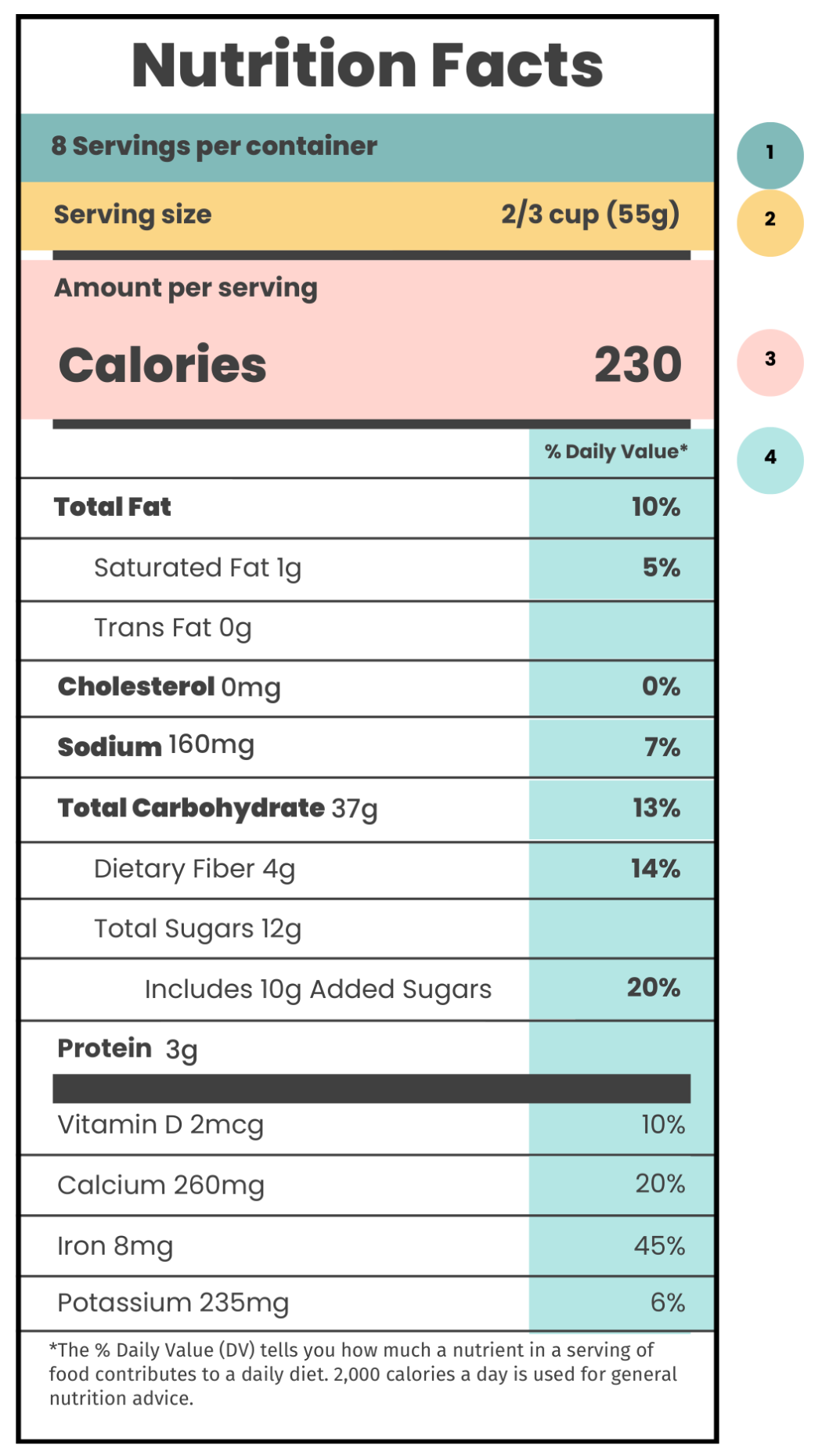
  • Servings Per Container shows how
    many servings are in a package. Check this because a package may contain more than one serving.
  • Serving Size indicates how much food is typically eaten at one time. It doesn't suggest how much you should eat. Nutrition facts are usually for one serving, but some labels include the whole package's nutrition facts.
  • Calories represent the energy in a serving of food. To maintain a healthy weight, balance the energy you consume with the energy you use. For weight loss, aim for 1,200-1,500 calories daily; for weight maintenance, about 2,000 calories.

    As a general guide:
    ‍
    •100 calories per serving of an individual
    packaged food is considered
    moderate
    • 400 calories or more per serving of an
    individual packaged food is considered
    high
  • % Daily Value (%DV) shows how much
    of a nutrient is in one serving of food
    . Use %DV to see if a food is high or low
    in a nutrient and to compare different
    foods, ensuring the serving sizes are the same.

    As a general guide:
    • 5% DV or less of a nutrient per serving is
    considered
    low.
    • 20% DV or more of a nutrient per serving
    is considered
    high.

Nutrients to get less of:
Saturated fat, sodium, and added sugars. Compare and choose foods to get less than 100% DV of these nutrients each day.

Nutrients to get more of:
‍
Dietary fiber, vitamin D, calcium, iron, and potassium. Compare and choose foods to get 10% DV of these nutrients on most days.

Action Steps for a Healthy Diet

Use the Nutrition Facts label and other parts of the food label to help you make healthy food choices. Small changes can add up and make a big difference!


  • Eat a variety of colorful vegetables (fresh, frozen, canned, and dried) and 100% vegetable juices.
  • Make at least half your grains whole grains. Try whole grains (such as brown rice or corn tortillas) instead of white rice, white bread, flour tortillas, etc.
  • Focus on whole fruits (fresh, frozen, dried, and canned in 100% fruit juice). Try fruits as snacks and desserts.
  • Protein isn't just meat! Try beans, peas, lentils, fat-free or 1% low-fat dairy products, eggs, lean meats like chicken, seafood, soy products, nuts, and seeds.