Every day across the Salinas Valley, known as the “salad bowl of the world” for its agricultural production, a Spanish-speaking worker sees a doctor. They’re told they need a blood test and walk out with a piece of paper — a requisition — that tells them to go to a lab. They look up the address. They drive there.
Then something goes wrong.
Maybe the front desk staff doesn’t speak Spanish. Maybe the lab requires a referral from an affiliated provider, and this doctor isn’t one. Maybe the name on the requisition doesn’t exactly match the name in the system. Whatever the reason, they leave without getting the test done.
The doctor never gets results.
The care never happens.
And whatever was being monitored — diabetes, kidney function, blood pressure — quietly gets worse.
We’ve watched this happen to our own patients. They call us from inside the lab, frustrated and confused, and hand the phone to a staff member so we can translate.
About 1 in 4 patients referred for a diagnostic test never complete it. That number represents a structural failure that falls hardest on communities often labeled “hard to reach.” But MiSalud Health isn’t trying to make the existing system easier to reach for Spanish speakers. We’re building a different system, with a care journey built around them.
MiSalud Health was built around the premise that healthcare should meet people where they are, in the language they speak, in a system that trusts them rather than treating them as hard to reach. We’ve proven that model works, with 80% patient engagement, measurable health outcomes, and bilingual care teams that patients ask for by name.
But we kept running into the same wall. We could build patients a care plan, provide care navigation to in-network specialists, and touch base regularly to support them over time — but tracking their health metrics meant sending them into a lab system that felt like a completely different world. Rigid referral rules. No continuity with the rest of their care. Too often, no Spanish. And when something went wrong, there was no one to call.
Owning the diagnostic piece of the care journey is the missing link that makes everything else work better.
We’re announcing two things today — one that’s already underway, and one that’s coming later this year.
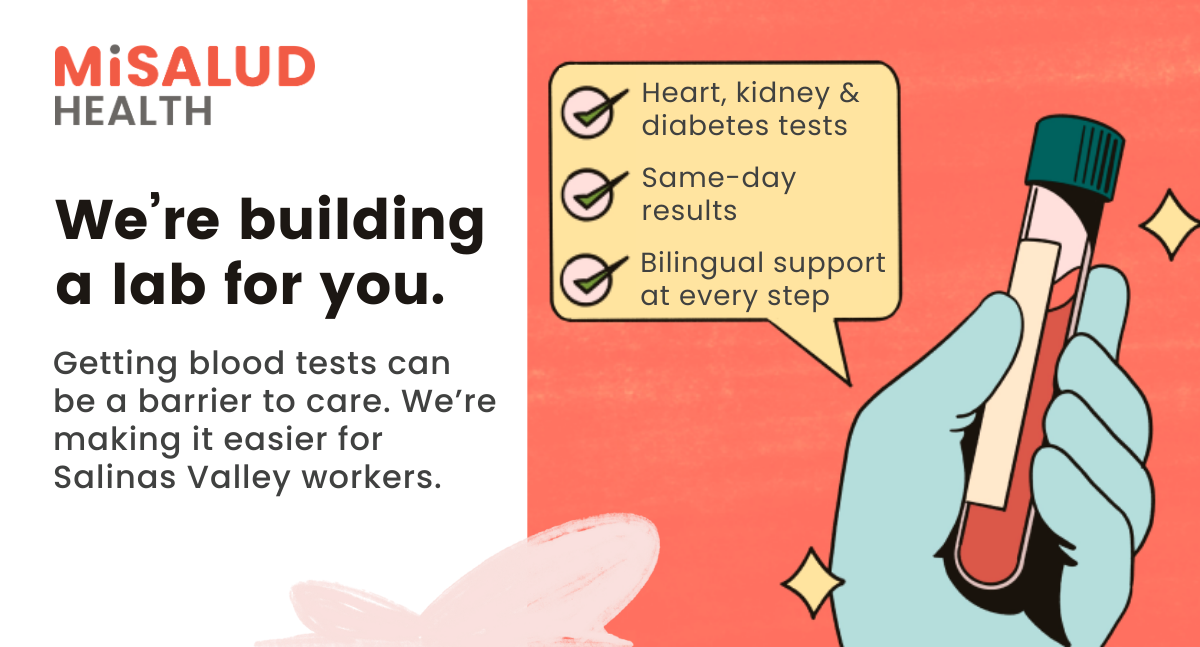
We’re bringing portable, point-of-care screening stations directly to agricultural operations, food processing facilities, and other worksites we already partner with across the Salinas Valley. A California-licensed phlebotomist will be available to do blood draws during employees’ shifts to measure cardiovascular and kidney health indicators. Results will come back the same day through MiSalud’s AI-driven health platform.
No referral required. No insurance requirement. Open to everyone at the work site.
We’re building a brick-and-mortar lab that will be open to the general public, with transparent pricing lower than national lab chains. Anyone will be able to walk in with a requisition from any physician — not just affiliated providers. If they don’t have one, there’s a direct line to our care team on-site. Results will be posted in 24–48 hours to the MiSalud Health’s digital platform, so patients can immediately discuss next steps on a telehealth appointment with the MiSalud Care Team.
The Salinas Valley has lab options. That’s not the problem. The problem is that those options weren’t designed for the people who need them most. Requisitions get rejected because they came from an out-of-network provider. Patients get turned away because of a name mismatch between the order and their ID. Results don’t flow back to the right care team. Nobody follows up on an abnormal finding because there’s no one responsible for the whole journey.
We’re integrated by design. When you get a test through MiSalud Health, your results go into the same record your health coach and physician are working from. If something is abnormal, someone calls you to explain it in your preferred language–and you can connect before, during or after a shift schedule, with extended hours from 7 a.m. to 8 p.m. Pacific. If you need a follow-up appointment, it gets scheduled then. The test isn’t a separate event. It’s part of your care plan.
We’ve also invested deeply in what happens at the front door. Our staff is bilingual. We know that “refused to show ID” and “gave wrong date of birth” are usually translation problems, not patient problems. We know that the people who don’t show up to their lab appointments aren’t being difficult — they’re navigating a system that was never built to make it easy for them. That changes here.
More details on the Salinas walk-in lab — including location, hours, and how to connect — are coming soon. If you’re an employer in the region interested in bringing screenings to your worksite, or a patient who wants to learn more about what’s available now, reach out to us at misaludhealth.com.